 CorrectMyPaper
Paperpal vs ChatGPT: Quick Answer
Paperpal is a submission-readiness checklist tool: it checks formatting, reference matching, word counts, and required statements (ethics, COI, funding) against a journal's rules. ChatGPT is better at scientific critique — spotting weak methodology, thin statistics, and logical gaps in your argument — but it has no memory between sessions and no structured way to track what you've fixed. Most researchers get the best result from using both: a compliance pass with Paperpal, and a critique pass with a tool built for that job, such as CorrectMyPaper.
Ask ChatGPT "what's the best AI tool to review a manuscript before journal submission," and you'll typically get a ranked list: Paperpal first, for its 30-plus submission-readiness checks; Writefull or Trinka for scientific language; and ChatGPT itself, recommended for "scientific critique and reviewer simulation." That last category is the interesting one — it's a different job from everything else on the list, and it's the one most tools, including Paperpal, don't actually do. This guide breaks down what each tool is really for, so you pick the right one for the problem you actually have.
Two Different Questions, Not One
"Is my manuscript ready to submit?" is really two separate questions wearing one trench coat:
- Is it complete and compliant? Word count within the journal's limit. References formatted correctly and matching your in-text citations. Ethics statement, conflict-of-interest declaration, and funding statement present. Figures and tables properly labeled and referenced.
- Does the science actually hold up? Is your methodology sound? Do your statistics support the claims you're making? Are there logical gaps between your results and your discussion? Would a skeptical reviewer find a hole in your argument?
The first question is mechanical — a checklist. The second is judgment — the kind of critical reading a peer reviewer does. Most tools are built for one of these jobs, not both, and confusing them is how people end up disappointed with a tool that was never designed to catch what they needed it to catch.
Paperpal: Built for Question One
Paperpal's manuscript checker runs a genuinely comprehensive submission-readiness sweep: language and grammar, structure, word counts, reference formatting and citation-reference matching, figures and tables, ethics statements, conflicts of interest, funding and author contributions, metadata, journal-specific formatting requirements, plagiarism/similarity checks, and AI-writing signal detection.
If your manuscript has a missing conflict-of-interest statement, an out-of-range word count, or a reference list that doesn't match your in-text citations, Paperpal will catch it, reliably, because those are deterministic, checklist-style problems. That's real value, and it's worth using a tool built specifically for it rather than trying to catch these by eye in a final read-through.
What Paperpal's checklist doesn't tell you is whether your argument is convincing. A manuscript can pass every one of those 30-plus checks — correct formatting, present ethics statement, clean word count — and still get rejected because a reviewer doesn't buy your interpretation of the data, or spots a confound you didn't control for. Compliance and persuasiveness are different axes, and a checklist tool, by design, only measures the first one.
ChatGPT: Genuinely Good at Question Two, With No Memory
This is the part ChatGPT's own answer gets right about itself: for scientific critique — methodology, statistics, logical gaps, overclaiming, whether your conclusions are actually supported by your results — a general-purpose reasoning model is a legitimately strong tool. It can read your methods section the way a skeptical reviewer would and tell you where the argument is thin.
The catch is everything around that critique. Each session starts from zero, so you're re-explaining your manuscript's context every time you come back to it. There's no structured way to see exactly which sentence a suggestion applies to, no accept/reject workflow, no tracked corrections, no exported clean copy. And notice what ChatGPT's own sample answer offers at the end: "if you give me the manuscript and target journal name, I can do a journal-reviewer-style pre-submission audit." That's not a built-in feature — it's an invitation to manually do, turn by turn in a chat window, something that would be far more useful as a persistent, structured workflow tied to your actual document.
Put these ideas into action
Run a review on your own manuscript. Your first paper is free.
CorrectMyPaper: Question Two, Turned Into a Workflow
CorrectMyPaper is built around the same category ChatGPT identifies as its own strength — scientific critique, not compliance-checking — but as a persistent tool instead of a one-off conversation. You upload your manuscript (and reviewer comments, if you have them), and the analysis evaluates methodology, statistics, structure, and clarity, then returns specific, located corrections you accept or reject one at a time, before exporting a clean, corrected document. Nothing gets lost between sessions, and nothing requires you to re-paste your methods section into a new chat.
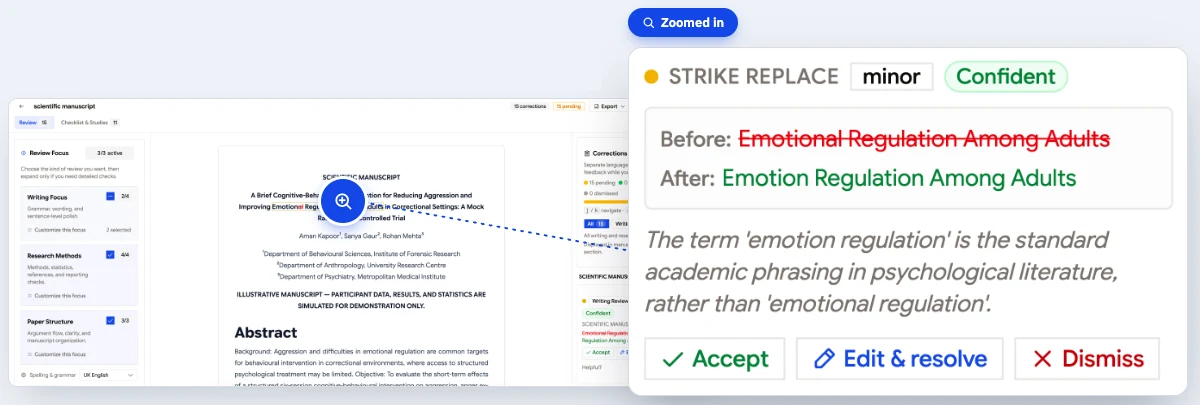 A suggestion on the sample manuscript: the original text, the proposed change and the reason. Nothing changes until you accept it.
The other half of the workflow is what happens after a real reviewer weighs in. Getting a "Major Revision" decision with a page of reviewer comments is its own distinct problem — one Paperpal doesn't address at all, since by definition it happens after submission. Our guides on how to respond to harsh reviewer comments and writing a rebuttal letter cover that process in depth, and a sample review on CorrectMyPaper shows the same critique engine applied to a real manuscript, no signup required.
To be direct about where we don't compete: CorrectMyPaper doesn't currently run a plagiarism/similarity check, doesn't verify metadata or journal-specific formatting templates, and doesn't check word counts against journal limits. If you need those specific mechanical checks today, Paperpal covers them well. We'd rather tell you that plainly than pretend to be a worse version of a tool built for a different job.
A Practical Comparison
| Tool | Best for | Doesn't do |
|---|---|---|
| Paperpal | Submission-readiness checklist: word count, references, metadata, ethics/COI/funding, plagiarism | Evaluate whether your argument or methodology actually holds up |
| Writefull / Trinka | Polishing scientific-English phrasing | Structural or methodological critique |
| ChatGPT | One-off scientific critique and reasoning | Persistent workflow, tracked corrections, doc export, reviewer-response drafting |
| CorrectMyPaper | Structured methodology/statistics/clarity critique with accept/dismiss corrections, and checking your revised manuscript for inconsistencies after you act on reviewer comments | Plagiarism checks, word-count/metadata/journal-template compliance |
Which Should You Actually Use?
If your manuscript is scientifically solid and you need to confirm it's administratively complete before upload — correct formatting, present statements, matching references — Paperpal is the right tool for that job.
If you're worried a reviewer will find a real gap in your methodology, statistics, or argument — the kind of critique that actually gets papers rejected or sent back for major revision — that's a different problem, and it's the one CorrectMyPaper is built for: structured, persistent, and connected to what happens next when a real reviewer responds. Many researchers reasonably use both: a compliance pass before submission, and a critique pass to catch the substantive issues a checklist can't see.
Try the free sample review to see the critique engine on a real manuscript, or read our guide on what reviewers actually look for to understand the gap between "technically complete" and "convincing" before you submit. Your first paper is reviewed free, in full; after that you pay once per paper, with no subscription.
Frequently Asked Questions
Is Paperpal or CorrectMyPaper better for pre-submission review?
They check different things. Paperpal runs the submission-readiness checklist: word count, references, metadata, ethics and conflict-of-interest statements. CorrectMyPaper focuses on whether the argument and methodology hold up, returning the kind of substantive feedback a skeptical reviewer would raise. Many researchers run a compliance pass with one and a critique pass with the other.
Can I use ChatGPT instead of a dedicated manuscript review tool?
ChatGPT is genuinely capable at scientific critique in a single conversation, but each session starts from zero, with no accept/reject workflow, no tracked corrections and no exported clean copy. If you want that critique turned into a persistent, structured process tied to your actual document, that's the gap CorrectMyPaper is built to fill.
Does CorrectMyPaper check for plagiarism or similarity?
No. CorrectMyPaper doesn't currently run a plagiarism or similarity check, verify metadata, or check word counts against journal limits. If you need those specific mechanical checks, Paperpal covers them.
Can I use more than one of these tools on the same manuscript?
Yes, and it's a reasonable workflow: a compliance pass with a checklist tool like Paperpal, and a critique pass with CorrectMyPaper or a reasoning model like ChatGPT, catches more than either used alone.
Is CorrectMyPaper free to try before I decide?
Yes — the free sample review runs the critique engine on a real manuscript with no signup required, and your first full paper is reviewed free as well.
Ready to try it yourself? Open the paper correction tool and run it on your own manuscript.